How to make a family flood communication plan
Create a family flood communication plan before heavy rain: follow warnings, choose safe meeting places, assign roles, and prepare for phone outages.
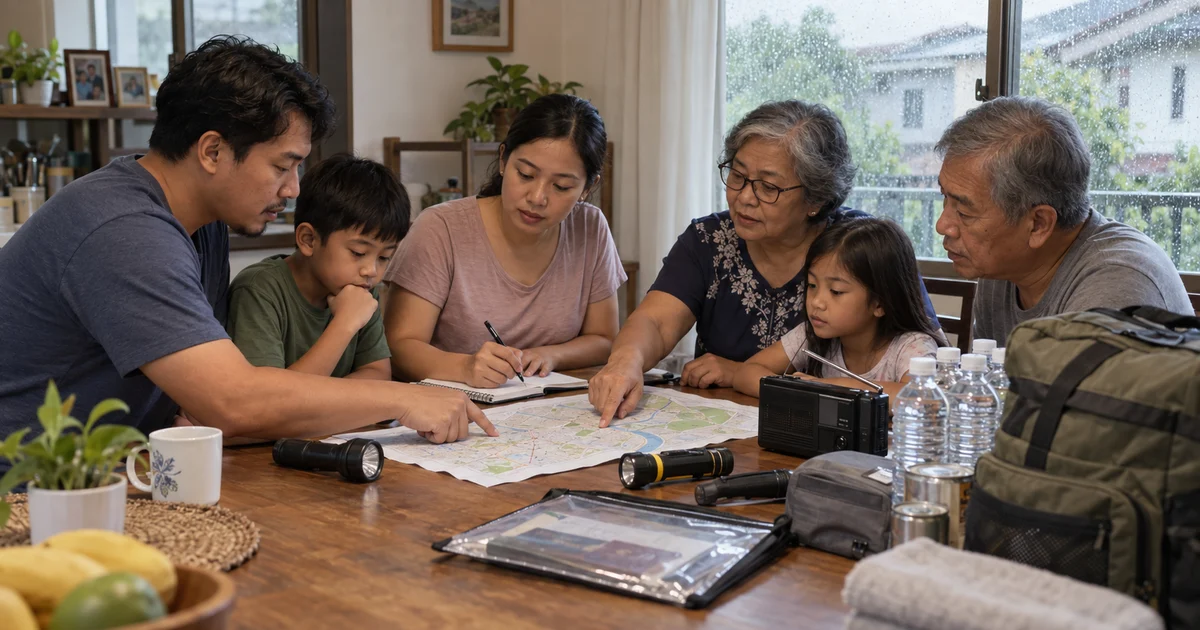
A flood communication plan should be made while the table is dry, the phones are charged, and everyone has time to ask questions.
During heavy rain, families may be at work, school, home, or on the road. Mobile networks may be congested, familiar routes may become unsafe, and an instruction from local authorities can change the plan immediately. The purpose of planning is not to predict the exact flood. It is to give each person safe defaults when the situation is changing.
Begin with official local information
Write down where your household receives verified weather warnings, flood advisories, evacuation orders, and shelter information. In the Philippines, that may include PAGASA flood information, the local government, barangay announcements, and the responsible disaster risk reduction and management office.
PAGASA’s flood safety guidance advises families to understand the local warning system, monitor weather conditions, designate an evacuation area, assign responsibilities, and leave for a safe area before floodwater cuts off access. Official instructions always override a household’s preferred route or meeting point.
Make sure every adult understands the warning terms used locally and what action each level requires. Do not wait for water to enter the home before discussing whether to leave.
Choose safe destinations, not convenient ones
Record at least two destinations:
- The official evacuation center or another authority-approved safe location
- A backup location on safe high ground if the first cannot be reached
Include the full address, recognized entrance, and more than one route. Check whether the locations can support older adults, children, pets, medication refrigeration, mobility devices, or other access needs in your household.
Never select a meeting place simply because it is halfway between family members. It must be safe to reach under flood conditions. Ready.gov’s flood guidance emphasizes evacuating when instructed, moving to higher ground when appropriate, and never walking, swimming, or driving through floodwater. A familiar shortcut is not a safe route if water covers it.
Name one coordinator and one outside contact
Choose a household coordinator who gathers updates and sends the current decision. Then choose a trusted contact outside the affected area. Local calls can be difficult when networks are busy; an outside contact can collect short status messages and tell relatives what is known.
The Ready.gov family communication plan recommends identifying meeting places, choosing a lead person to communicate the meeting location, discussing how each person will get there, and keeping important phone numbers written down.
Use a compact status format:
SAFE - with Lolo - Central School evacuation center - 12:40 p.m. - battery 35%
If a message has not been delivered, do not assume the worst. Try the agreed backup method and contact the responsible authorities when someone may be in danger. Do not send relatives onto unsafe roads to investigate.
Assign responsibilities before a warning
List jobs by name. One adult may collect medicines and identification documents. Another assists a relative with limited mobility. An older child may carry their own small bag but should never be made responsible for evacuating a younger child alone.
Include:
- Who receives official alerts and confirms evacuation instructions
- Who helps each child, older adult, person with a disability, and pet
- Who carries medicines, documents, chargers, and water
- Who contacts the outside coordinator
- Who checks the home only when it is safe to do so
Pack supplies appropriate to local guidance and household needs. Keep important documents in a waterproof pouch and maintain password-protected digital copies. Put a paper contact card in every go-bag because a saved number is not useful when a phone is dead or missing.
Practice without making children afraid
Walk through the plan on a normal day. Show children the safe meeting location, identify trusted adults, and explain that floodwater is not a place to walk or play. The American Red Cross advises households to plan for likely hazards, assign responsibilities, choose both nearby and outside-neighborhood meeting places, select an out-of-area contact, and practice the plan.
Use calm, age-appropriate language. Ask each person to explain the plan back in their own words. Correct misunderstandings now, then review the plan when phone numbers, schools, work locations, health needs, or evacuation sites change.
Treat technology as a backup layer
Phones are helpful, but the plan must still work with low battery, weak data, inaccurate location, or no electricity. Save essential information offline and on paper. Use text messages when local authorities recommend them and keep calls brief unless the situation requires direct emergency contact.
If invited family members have already reached safe locations and mobile data is working, Nearby may help a small group converge inside or near an approved evacuation site. One Android user can start a temporary meetup and share a link that others open in the app or browser. Participation and live-location sharing are optional.
Nearby is not an emergency alert, rescue tool, flood map, evacuation guide, or proof that somebody is safe. Never delay evacuation to start a meetup, never follow an app pin across floodwater, and never use location sharing instead of contacting emergency services or local authorities.
A strong family flood communication plan has no heroic assumptions. It expects routes to change, phones to fail, and people to need help - and gives everyone a safer next action anyway.
Prepare on paper first. Use Nearby only as an optional coordination tool after family members are safe and official instructions allow movement.
Common questions
What belongs in a family flood communication plan?
Record official warning sources, evacuation routes, safe meeting places, an out-of-area contact, household responsibilities, important numbers, accessibility needs, and what each person should do if phones fail.
Where should a family meet during a flood evacuation?
Use the official evacuation center or another location on safe high ground approved by local authorities. Never choose a route or meeting point that requires crossing floodwater.
Should a family rely on a location-sharing app during a flood?
No. Mobile data, power, GPS, and phones can fail. Follow official warnings and evacuation instructions first, and use direct calls or texts when possible. Any app should only be an optional backup after people reach safety.