How club rides keep a cycling group together
Different abilities, mechanicals, and a regroup point nobody agreed on. The etiquette and the practical planning that keeps a group ride social.
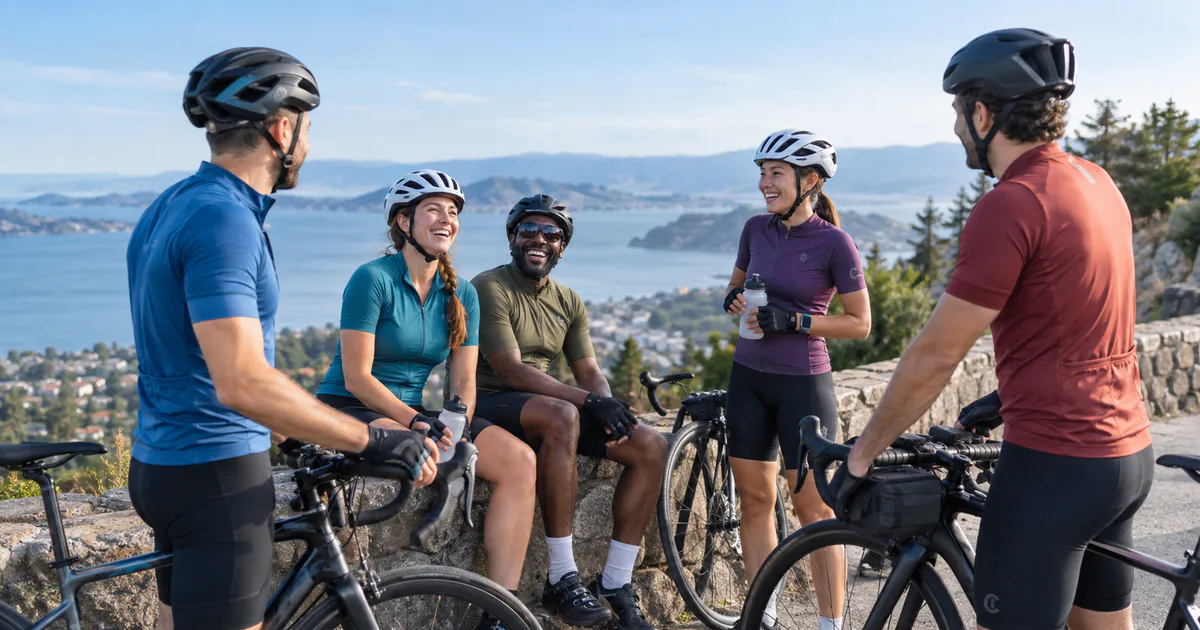
Group rides split for three reasons: climbs, junctions, and mechanicals. All three are predictable, which means all three can be planned for.
The underlying etiquette is simple and old: a group ride is a social ride, and the group rides at the pace of its slowest member. Everything else follows.
Before you roll out
Share the route file. Every rider loads it onto their own computer or phone. A group where only the leader has the route is fragile: one puncture at the back and you have a lost group and a waiting group.
Brief the regroup points. Top of each climb, and at any junction where the route turns. Say them out loud so everyone can ride their own pace between them knowing where they will be reunited.
Set the pace honestly. If it is a 28 km/h ride, say so, and mean it. Most upset on club rides comes from a ride advertised as one pace and ridden at another. Many clubs run separate paced groups precisely to avoid this, and that is a good system.
Check the basics. Spares, tubes, a pump, and enough food. One rider without a tube becomes the whole group’s forty-minute delay.
The three split points
Climbs. This is the big one - ability differences show up most on gradients. The convention that works: everyone climbs at their own pace, and the group regroups at the top. Faster riders get their effort, slower riders are not shelled, and nobody waits at the bottom feeling awkward.
Junctions. Whoever is in front waits where the route turns. Simple and it prevents almost all wrong turns.
Mechanicals. Nobody is left alone. At least one other rider stops, always, and if the group is large the rest soft-pedal or wait at the next regroup point. This is non-negotiable etiquette in most clubs and for good reason - a lone rider with a mechanical, in the cold, far from home, is a genuine welfare problem.
Communication on the road
You cannot look at a phone while riding, so the group’s communication is verbal and physical: calling out holes, cars, gravel, and slowing; pointing out obstacles; shouting “mechanical” or “stopping”.
Location sharing plays no part while moving. Its use is at the stops - at the café, at a regroup, or when the group has split and someone needs to know whether the missing pair is two minutes back or has taken a wrong turn five kilometres ago.
Where Nearby fits
We build Nearby, so read this as interested, and with a clear limit: it is not a cycling app. No route file support, no live tracking for a following car, no incident detection. Your head unit and a route file do the ride; a dedicated cycling platform does the training.
Where it is useful is the social logistics:
- The café stop or the start point as a pin, shared with everyone, so nobody is deciphering directions to a rural café.
- Riders meeting the group partway, which is common on club rides and otherwise involves phone calls.
- After a split, checking whether the missing riders are behind you or elsewhere - which decides whether you wait or ride back.
Everyone joins from a link in a browser, so a guest rider on a club run does not need to install anything. It expires afterwards, which suits a Sunday ride.
For rides on two wheels with engines, the etiquette is stricter - see group motorcycle rides.
The club ride checklist
- Route file on every rider’s device.
- Regroup points briefed: top of climbs, and every junction.
- Advertise the pace honestly, and ride it.
- Nobody left alone with a mechanical.
- Spares and food checked before rolling out.
- Pin the café stop so nobody has to navigate by description.
Nearby is free on Google Play, and riders joining partway can find the group from any browser.
Common questions
How do cycling groups stop dropping riders?
Ride at the pace of the slowest rider, regroup at the top of every climb and at every junction, and never leave anyone alone with a mechanical. Most clubs also run separate paced groups so nobody is permanently off the back.
What should you do if you get dropped on a group ride?
Keep riding to the next agreed regroup point at your own pace rather than burning yourself out chasing. That only works if the regroup points were agreed at the start, which is why briefing the route matters more than any app.
Should everyone have the route on a group ride?
Yes. Load it onto every rider's computer or phone before setting off. A group where only the leader knows the route is one puncture away from splitting into a group that is lost and a group that is waiting.