Keeping a group motorcycle ride together, safely
Staggered formation, a sweep rider, hand signals, and what to do when someone drops back. How experienced groups run rides that do not lose people.
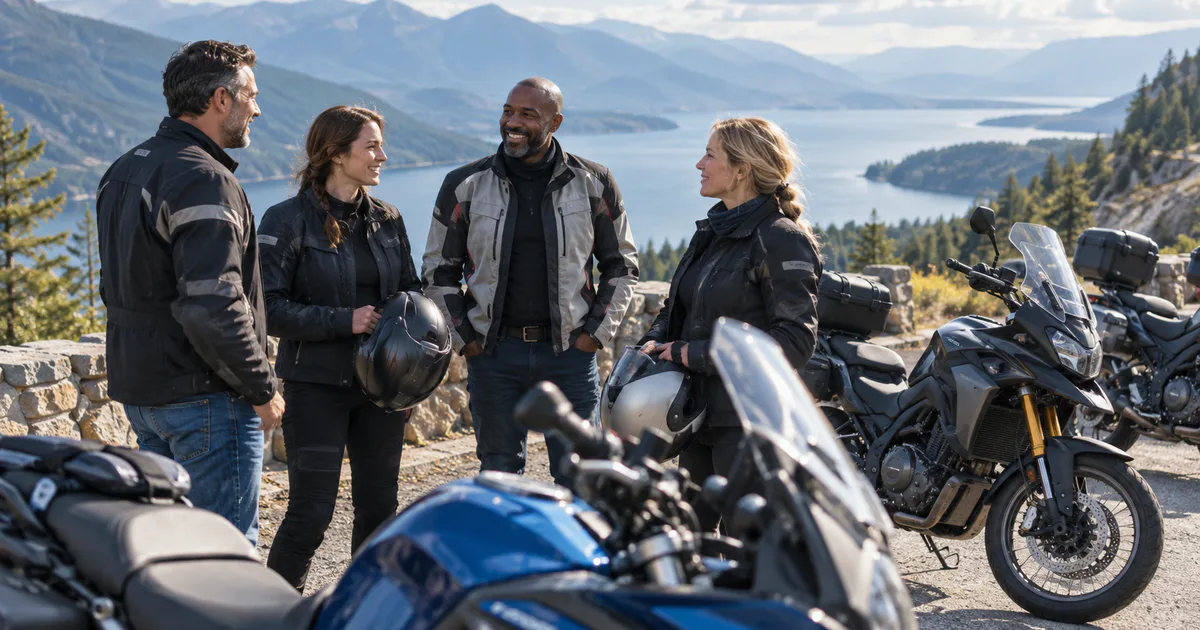
Group rides fall apart in a predictable order: the group gets strung out at a junction, the back half takes a different exit, somebody’s fuel light comes on, and nobody at the front notices for twenty kilometres.
The established riding disciplines exist precisely because of this, and they work. Technology is the layer on top, not the solution.
The formation and the roles
Ride staggered. The lead rider takes the left third of the lane, the second rider the right third, the third rider the left again. Each rider keeps roughly a two-second gap to the rider two ahead on their own side, and about one second to the one diagonally in front. It keeps the group short without putting anyone in a box.
Single file for bends, narrow roads, and poor surfaces.
Assign the two jobs before you set off:
- The leader sets the pace and the route. They should be pacing for the least confident rider, not for themselves.
- The sweep rides at the back, is experienced, and owns the rule that nobody gets left behind. If a rider pulls over, the sweep pulls over with them.
Put newer riders in the middle. They are protected, they are visible, and they are never chasing.
The riders’ briefing
Five minutes before you roll, standing still, covering:
- The route, and the fuel and rest stops by name.
- The hand signals you will use, so everyone is using the same ones - slow down, hazard, single file, fuel, all-stop.
- What happens if the group splits at lights or a junction: the group ahead pulls over safely at the next sensible point, and nobody runs a light to stay together.
- Everyone’s realistic fuel range. Small tanks dictate the stops, and a rider running dry twenty kilometres from a station is the classic group-ride failure.
- That nobody is expected to ride beyond their comfort. Say it explicitly, because newer riders will not say it themselves.
Why phones are the wrong tool while moving
You cannot look at a map while riding, so a live map is not a navigation aid on a bike - it is a stop-time tool. Intercoms are the real-time channel for groups that use them; everything else waits for a stop.
This changes what location sharing is for on a ride. It is not about watching dots move. It is for the moment the group pulls in at a services and wants to know whether the missing two riders are five minutes back or took the wrong exit fifteen kilometres ago. That answer decides whether you wait or ride back.
Where Nearby fits
We build Nearby, so weigh accordingly, and note one thing up front: it is a meetup map, not a rider-safety system. It does not do crash detection, stop alerts, or automatic drop-back warnings - dedicated group-riding apps do, and if your club needs those, use one.
What it does well for a ride is the ordinary stuff:
- The pin is the next stop, visible to everyone, with a live ETA. That removes most of the “where are we meeting?” chat.
- Everyone joins from a link, including riders on iPhones and the friend-of-a-friend who came along on this one ride and is not installing a club app. No account, no sign-up.
- It ends when the ride ends. No permanent tracking of people you ride with occasionally.
Honest limits: it needs data, and the best roads are frequently the ones with no coverage. The briefing, the sweep rider, and the named stops are the system. The map is a convenience at the stops.
For cars, the rules are looser and the pace is different - see keeping a convoy together on a road trip.
The pre-ride checklist
- Brief the route and the named fuel stops.
- Assign a leader and a sweep.
- Agree hand signals, out loud.
- Newer riders in the middle; pace set by the least confident.
- Agree what happens at a split: pull over safely ahead, never run a light.
- Check everyone’s fuel range before you rely on the plan.
Nearby is free on Google Play, and riders join the map from any browser at the stop.
Common questions
What formation should a group of motorcycles ride in?
Staggered, not side by side. The leader takes the left third of the lane, the next rider the right third, and so on, each keeping around a two-second gap to the rider two positions ahead on their own side. It gives everyone space to move and keeps the group compact.
What is a sweep rider?
The experienced rider at the very back whose job is making sure nobody is left behind. If a rider stops, the sweep stops with them. Having a designated sweep is the single most effective way to stop a group losing someone without noticing.
Where should less experienced riders be placed in a group?
In the middle, with the least confident rider setting the pace at or near the front. Nobody should ever be riding beyond their skill level to keep up, and the group's pace should be the slowest rider's comfortable pace.