A family earthquake meeting plan that works after shaking
Create a family earthquake meeting plan with safe reunion points, an outside contact, paper backups, and clear steps for aftershocks and damaged routes.
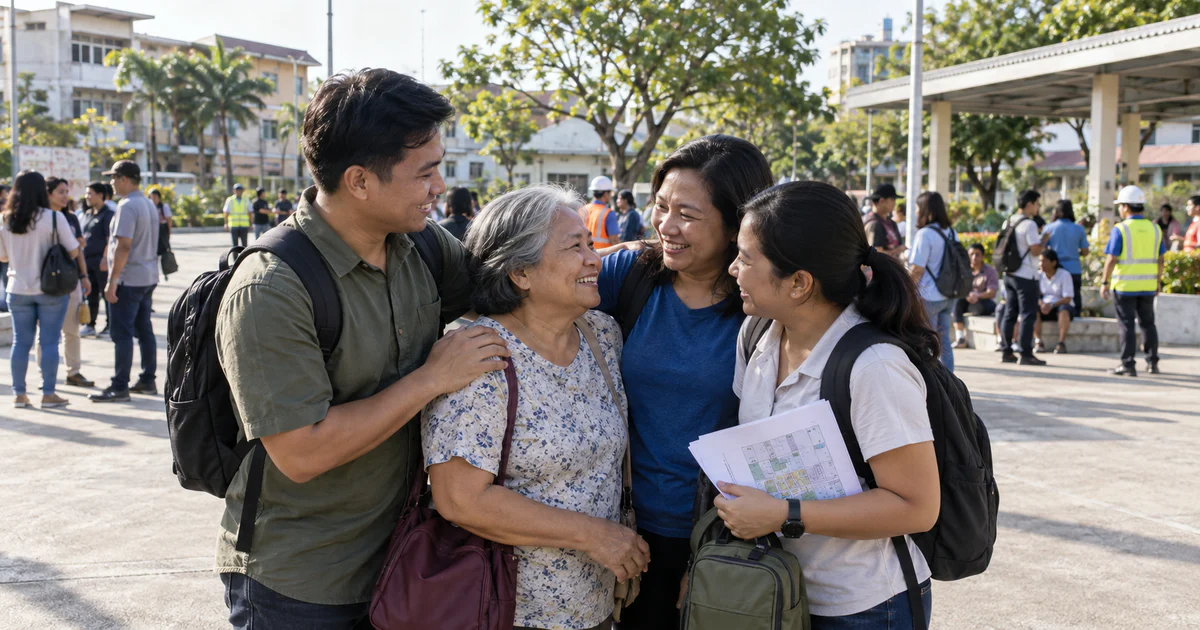
An earthquake family plan should answer a difficult question before the ground moves: if everyone is in a different place and home cannot be reached, what does each person do next?
The answer is not “follow the map home.” After strong shaking, buildings, roads, bridges, slopes, power lines, and coastal areas may be unsafe. A useful plan begins with individual safety, official information, and two pre-agreed reunion points.
Protect yourself before trying to reconnect
During strong shaking, DOST-PHIVOLCS advises people to Drop, Cover, and Hold. Its guidance after the June 2026 offshore Sarangani earthquake also warned communities to prepare for aftershocks, avoid weakened structures, seek inspection before reoccupying damaged buildings, and rely on verified official information.
Do not run across a room for a phone or try to reach a meeting point while shaking continues. When it stops, check for immediate danger and follow the evacuation procedure for the building, school, workplace, or venue. Expect aftershocks and protect yourself again when they occur.
People near the coast must also know the local tsunami plan. Strong or long shaking, an unusual rise or fall of the sea, or a roaring sound can require immediate movement to higher ground. A family reunion never takes priority over tsunami evacuation.
Choose two safe reunion points
Pick one nearby assembly point for a localized emergency and another outside the neighborhood if home is inaccessible or evacuation is ordered. Use places identified or accepted by the local government, building management, school, or community disaster office.
A meeting point should be:
- In an open area away from walls, glass, posts, and overhead hazards
- Reachable without using a damaged building or lift
- Outside mapped tsunami, landslide, liquefaction, or other known hazard areas where applicable
- Recognizable without a working phone
- Accessible to children, older adults, and relatives with disabilities
Write the full name and location. “The covered court” is too vague if the community has two. Add the entrance or assembly zone and identify a backup if it is closed.
The Red Cross family emergency plan recommends both a near-home and an outside-neighborhood meeting place, plus an out-of-area contact who may be easier to reach when local lines are overloaded.
Give everyone a safe default
Family members should not cross the city immediately just because they cannot make contact. Give each person a default based on where they normally spend the day:
- Children follow the school’s reunification procedure and leave only with an authorized adult.
- Workers follow building and local authority instructions before attempting to travel.
- A relative at home uses the household assembly point only if the route and destination are safe.
- Anyone at the coast, on a slope, or near visible damage follows the hazard-specific evacuation direction first.
Choose one family coordinator and one out-of-area contact. A useful status message is short:
SAFE - Mara - office assembly area B - 10:42 a.m. - staying here - battery 31%
Include who is with you, the verified location, the time, an urgent need, and whether you are staying or moving. “Safe” means directly confirmed, not inferred from a social post or map icon.
Keep the plan on paper
Every person should carry a small contact card with the two meeting places, family coordinator, outside contact, and essential numbers. Place a copy in school bags, work bags, wallets, and the household emergency kit. Review it when a school, workplace, address, or phone number changes.
Practice the plan without creating panic. Ask each person to explain where they would go from school, work, or a usual weekend location. Check whether an older relative can reach the point without a lift and whether a child knows which trusted adult or staff member to approach.
Use Nearby only when conditions allow
If relatives have reached safe areas, authorities permit movement, and mobile data is working, Nearby may help invited family members converge on the correct public assembly point. The temporary meetup works through the Android app or a browser, and each participant controls whether to share a location.
Keep the pin on the approved assembly area. Do not use it to create a shortcut through a closed road, enter a damaged building, or decide that somebody is safe. Indoor and dense urban GPS can be inaccurate, and an unmoving phone may not be with its owner.
Nearby is not an earthquake alert, structural assessment, evacuation map, missing-person system, or rescue service. Contact the relevant authorities when somebody may be trapped, injured, or in danger.
A family earthquake meeting plan succeeds when nobody has to improvise a dangerous journey just to prove they are looking for everyone else.
Safety and official instructions come first. Use Nearby only as an optional reunion tool when communications are working.
Common questions
Where should a family meet after an earthquake?
Choose an open assembly area identified by local authorities and a second location outside the neighborhood. Avoid damaged buildings, power lines, slopes, coastlines with tsunami risk, and routes officials have closed.
Should family members travel home immediately after an earthquake?
Not automatically. Each person should first protect themselves, check official instructions, expect aftershocks, and remain at a safe location if roads or buildings may be dangerous.
Can Nearby locate family members after an earthquake?
No app can guarantee that. Power, mobile networks, GPS, and phones may fail. Nearby can only be an optional coordination layer when people are already safe and data service is working.