How to do a theme park with a group and not lose anyone
Different ride queues, different appetites, one flat park map. How to split up on purpose at a theme park and still find each other all day.
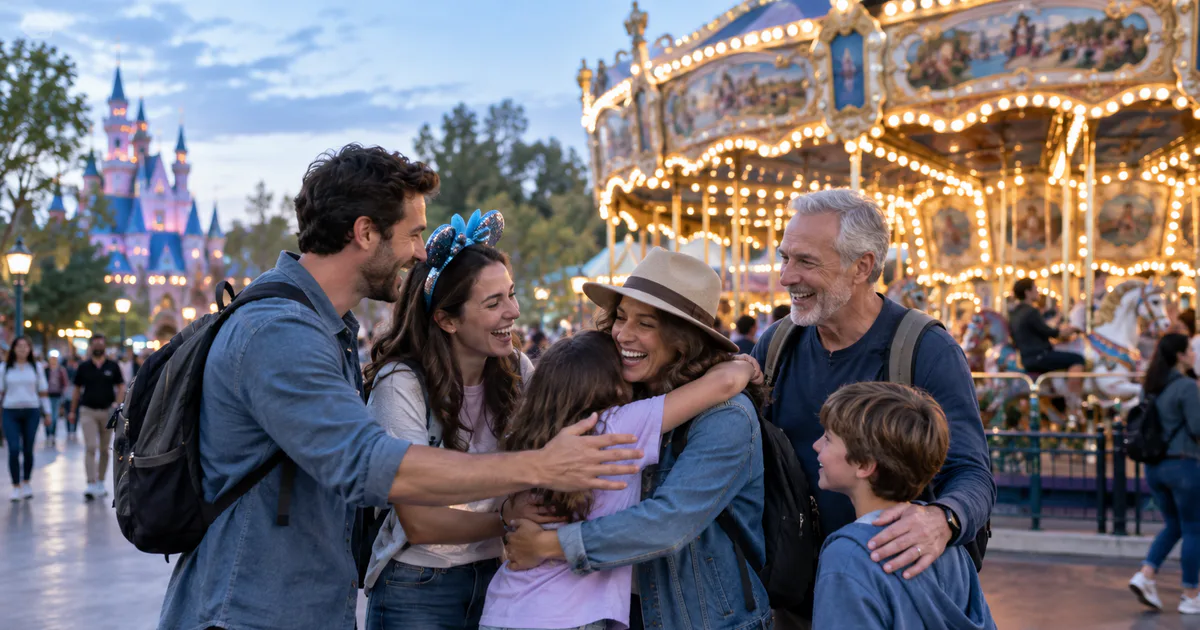
A theme park is the one group outing where splitting up is not a failure. It is the whole point.
Half the group wants the biggest coaster in the park. Someone will not go near it. There is a child who needs lunch at a fixed time and a teenager who does not want lunch at all. Trying to move eight people as one unit through six different queues is how you end up having ridden four things by six o’clock and being quietly annoyed with each other.
So the goal is not to stay together. It is to split up deliberately and regroup reliably.
Set the day up in the car park
Five minutes before you go through the turnstiles, while everyone is in one place and the phones still work.
Pick one landmark for the whole day. Not a different meeting point per hour - one. Something tall, central, and unmistakable: the fountain at the entrance, the castle, the big wheel. Avoid anything generic. “By the churros stand” is not a location in a park with nine churros stands.
Agree regroup times, not regroup triggers. “We all meet at the fountain at 1pm and again at 5pm” beats “text when you’re done”, because texting requires signal and everyone being free at the same moment. Two or three fixed checkpoints run the whole day with no coordination cost.
Name the adult for each child. Explicitly. Not “we’re all watching them” - a specific person for a specific child, and say it out loud. Groups lose children in the gap between two adults who each assumed the other had it.
Give every child the meeting point. Make them repeat it back. Add: “if you are lost, find someone who works here in a uniform.” Park staff are trained for exactly this and every park has a procedure.
Screenshot the park map. Park apps are heavy, the Wi-Fi is congested, and you will want the map most at the moment it will not load.
Through the day
- Announce the move, not the arrival. “Heading to the log flume” when you leave is useful. “We’re at the log flume” twenty minutes later is history.
- Queue times make people unreachable. Somebody deep in a ninety-minute queue is not checking their phone and cannot leave. Assume a silent person is in a queue, not lost.
- Pick lunch before you are hungry. The group that starts deciding at 1pm eats at 2:30. Put it on the checkpoint.
- Battery is the real risk. Park apps, photos, and constant map checking flatten phones by mid-afternoon, and the phone that dies belongs to the person everyone then cannot find. Bring a power bank and start the day at 100%.
Where a shared map genuinely helps
The value in a park is not dramatic rescue, it is removing the check-in messages. Nobody has to ask where anyone is or reply while queueing. You glance, you see the group is spread across three rides, you carry on.
It also fixes the slow regroup: at 1pm you can see who is already at the fountain and who is still four hundred metres away on a ride, so you do not stand there wondering whether to wait or start eating.
Where Nearby fits
We build Nearby, so read this as the interested party’s view.
The practical fit is the install problem. A theme park group is usually a mixed bag - some family, some friends, a couple of people’s partners, a mix of iPhones and Androids. Getting all of them to download and set up an app at a turnstile is not going to happen.
With Nearby, one person starts a meetup, drops the pin on the fountain, and sends the link to the group chat. Anyone with the app taps it and lands in the meetup. Everyone else opens the same link in their browser, types a name, and is on the map as a full member - iPhone included, no account, no install. Up to ten people, which covers most park groups.
The shared pin is the part that suits a park especially well: the landmark you agreed on is visible to everyone all day, so “where are we meeting again?” is answered on the screen rather than in the group chat.
And because a meetup expires rather than running forever, the day ends and the sharing ends with it.
The one-minute version
- One landmark for the whole day. Tall, central, unmistakable.
- Fixed regroup times, not “text me when”.
- One named adult per child, said out loud, and the child knows the landmark.
- Everyone on one map before the turnstiles, including the friend who will not install anything.
- Power banks, and screenshot the park map.
Then split up, ride what you actually want to ride, and stop negotiating.
Nearby is free on Google Play, and friends join your map from any browser. If your day out is somewhere with worse signal, read what to do when the signal dies.
Common questions
What is the best meeting point in a theme park?
Something tall, central, and impossible to confuse with anything else - the main entrance fountain, the central castle, or a single named landmark. Avoid anything there are five of, such as "the ice cream place", and avoid anything that closes during the day.
How do I keep track of a group at a theme park without losing the day to it?
Split up on purpose instead of trying to stay together by accident. Agree a regroup time and place, let people queue for what they want, and use a shared map so nobody has to send updates. Groups that insist on staying together spend the day negotiating rather than riding.
Do theme parks have good phone signal?
Usually better than a festival but worse than a high street, and it collapses at peak times near the busiest rides and during the parade. Park Wi-Fi helps in some areas and is often congested too, so treat data as unreliable and set a physical meeting point anyway.