School trip headcounts that actually work
Ratios, buddy pairs, and what to do when thirty children hit a museum gift shop at once. Practical systems for teachers and trip leaders.
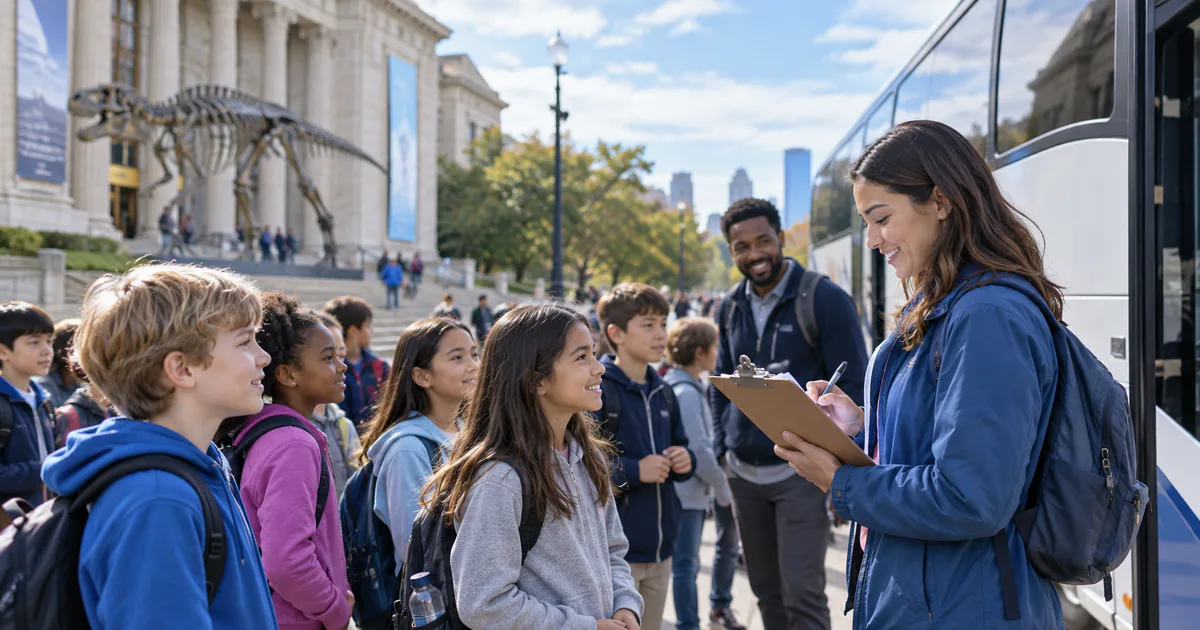
Children do not get lost during activities. They get lost at transitions - stepping off the coach, moving between floors, leaving the gift shop, changing zones. Anywhere the group stops being a group for thirty seconds.
Build your systems around transitions and most of the risk disappears.
The core system
Buddy pairs, assigned before you leave school. Each child knows their buddy’s name and is responsible for confirming their buddy is present. Thirty children become fifteen parallel checks, which takes about twenty seconds and works in a crowd where counting heads does not.
Small groups with a named adult. Each adult has a specific, written list of specific children - not a vague share of the class. The most common failure in supervision is two adults each assuming the other had a particular child.
Count at every transition, and say the number out loud to another adult so two people hold it.
Give every child the information
Every child should have, physically:
- A card with the school name, a staff mobile number, and the venue. In a pocket, not a bag that gets put down.
- The meeting point, pointed at when you arrive, not described in the classroom the day before.
- The rule: if you are lost, stop, stay where you are, and find a member of staff in uniform. Practise saying it back.
Children should not be given the teacher’s personal number on a card in a way that leaves it circulating; use a trip phone where your setting’s policy requires it, and follow your own safeguarding policy over anything in this article.
The venue has done this before
Museums, galleries, theme parks, and activity centres deal with lost children every single day and they have a procedure. Use it:
- Ask at the desk on arrival what their lost child procedure is, and where the meeting point is.
- Note whether staff are in a recognisable uniform, and show the children what it looks like.
- Ask whether there are quiet exits or unsupervised doors you should know about.
Free time, gift shops, and the coach
Gift shops are the single worst moment on most trips: everything is small, dense, and interesting, and thirty children spread into a space the size of a classroom with shelves in it.
- Send children through in groups, not all at once. Half the class waits outside with an adult.
- Give a time, a five-minute warning, and a clear exit point.
- On the coach, use seat numbers. A fixed seating plan makes an absence instantly visible and turns the count into reading a list.
Where a shared map does and does not help
Straightforwardly: for primary-age children, a shared map is not the tool. Most will not have phones, and supervision ratios plus buddy pairs are the system that actually keeps them safe.
Where it becomes useful is the adults. On a big site, staff are spread across zones and spend a lot of the day trying to find each other to hand over, swap groups, or deal with something. A shared map between the accompanying adults - not the children - removes that entirely, and lets a trip leader see which adult is nearest to a situation.
It also helps with older students on supervised free time, where a temporary, opt-in shared map for the afternoon is proportionate in a way that permanent tracking is not.
Where Nearby fits
We build Nearby, so treat this as interested, and note the limits plainly: it holds up to ten people, has no leader role, no roster, and no headcount readout. It is not a school trip management system and should not be relied on as a safeguarding control.
Realistically it is an adults’ coordination tool for a trip: the five or six staff and parent helpers drop a pin on the meeting point and share one link. Everyone joins from a browser, including parent volunteers who are not installing an app for one day, with no account and no sign-up. It expires the same day.
Your setting’s own risk assessment, ratios, and safeguarding policy come first, always.
The trip checklist
- Buddy pairs assigned before leaving.
- Named adult with a written list of named children.
- Card in every child’s pocket; meeting point pointed at on arrival.
- Count at every transition and share the number with another adult.
- Ask the venue for their lost child procedure on arrival.
- Seat numbers on the coach.
Nearby is free on Google Play. For adult coordination on a big site, the accompanying staff can join one map from any browser.
Common questions
What is the fastest way to count a class on a trip?
Buddy pairs. Each child is responsible for confirming one other child is present, so thirty children become fifteen simultaneous checks. It is faster than counting heads and far more reliable in a moving crowd or a dim venue.
How often should you headcount on a school trip?
At every transition - leaving the coach, entering a venue, changing floors or zones, before and after any free time, and boarding the coach again. Transitions are where children get left behind, not the middle of activities.
What should children be told to do if they get lost on a trip?
Stop, stay where they are, and approach a member of staff in uniform. Give every child the meeting point and a card with the school name and a staff phone number. A stationary child near staff is found quickly; a searching child moves away from the group.