Keeping track of children at a park or playground
Open space, several exits, and children who move faster than you think. Practical supervision habits, and an honest word about tracking kids.
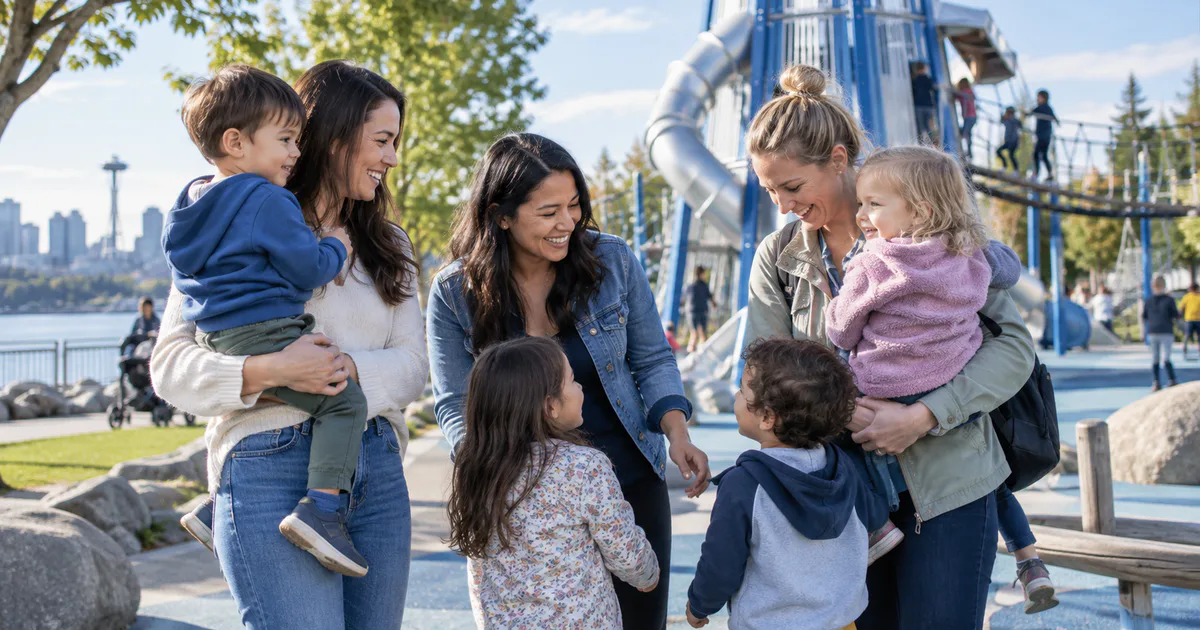
Parks and playgrounds are low-risk and high-anxiety. Children are meant to run around - that is the point - but the space is open, there are usually several exits, and every child under seven is wearing something navy.
A few habits do most of the work.
Set up before they run off
Assign specific children to specific adults. Not “we’re all watching them”. Say the names out loud. The most common supervision failure is two adults each assuming the other had a particular child.
Pick your spot for the view, not the comfort. Sit where you can see the exits and the main play structure rather than in the nicest patch of shade.
Note what each child is wearing, and take a photo on your phone at the start. If you ever need to describe them to someone, you will not have to remember under stress - you will have a picture from twenty minutes ago.
Bright colours help enormously. One child in a red or yellow top is visible across a playground; eight children in navy are not.
Teach the rule, and practise it
The rule that works, because it is simple enough to remember while upset:
Stop. Stay. Look for a helper.
- Stop moving immediately.
- Stay exactly there, because you are far easier to find standing still.
- Look for a helper - a parent with children, or someone who works here, or a uniformed member of staff.
Practise it, lightly, on the way in: “if you can’t see me, what do you do?” Children who have rehearsed it once do it; children who have only been told do not.
For older children, add where to go: a named gate, the café, the ice cream stand.
Check in without hovering
The parenting goal is not constant surveillance, it is letting a child range while staying reachable.
- Agreed check-ins. “Come back to this bench every fifteen minutes” or “come back when the big clock says half past”. It builds the habit of communicating.
- A meeting point they can name, chosen and pointed at when you arrive.
- Something in their pocket with a phone number, for younger children in a large or busy park.
An honest word about tracking children
There is a large market in tracking children continuously, and it deserves an honest note rather than a sales pitch.
Tracking has real value in specific situations: a big unfamiliar venue, an older child travelling alone, a child with additional needs who may wander. Those are genuine.
It also has costs that are less discussed. Continuous tracking can substitute for the conversation about where a child is going and when they will be back - and that conversation is the thing that scales as they get older, whereas tracking does not. A lot of families find agreed check-ins build more trust and, in practice, more information.
There is no universal right answer here. It is worth deciding deliberately rather than by default, and worth revisiting as children grow.
Where Nearby fits, honestly
We build Nearby, and it is not a child-tracking product. There is no ongoing visibility, no geofences, no alerts, no history, and a meetup expires after a couple of hours. If you want continuous family tracking, that is a different category of product and you should choose one deliberately.
What it is useful for on a family day out is the adults: two parents split across a big park, grandparents arriving separately, or two families meeting up who have never been to this park before. Drop a pin on the playground you are actually at - parks often have several - share the link, and the other family walks straight to you without a phone call.
For the bigger version of this problem, see theme parks with a group.
The park checklist
- Named adult for each named child, said out loud.
- Sit where you can see the exits.
- Photo of each child at the start; bright colours help.
- Teach and practise: stop, stay, look for a helper.
- Agree a meeting point and point at it on arrival.
- Check-ins rather than hovering.
Nearby is free on Google Play. Useful for the adults meeting up; not a child tracker.
Common questions
What should you teach a child to do if they get lost?
Stop where they are and stay put, then look for a specific kind of helper - a parent with children, someone working at the venue, or a uniformed member of staff. Moving to search for you takes them further away and makes them much harder to find.
At what age should a child have a phone for location tracking?
There is no single answer, and it depends far more on the child and the situation than on age. Many families find that agreed check-in times work better than continuous tracking, because they build the habit of communicating rather than the habit of being watched.
How do parents keep track of multiple children at a playground?
Assign each adult specific named children rather than sharing supervision generally, pick a spot with a view of the exits, and dress children in bright, memorable colours so they are easy to pick out in a crowd.